
At a glance
A performance review framework is a vital foundation, but it isn't enough on its own to grow your people's careers. Managers need to work in two separate modes: evaluator, when they assess performance against expectations, and coach, when they help people amplify what's going well and close any gaps. Keep those conversations apart, and have the coaching ones regularly, not just at review time.
Key Takeaways
A performance management framework is a no brainer, but it's only the foundation.
If review time is the only time you talk about performance and development, expect surprises, patchy memories and recency bias.
Evaluator and coach are two different jobs. Managers can't do both in the same conversation.
People rarely hear coaching right after they've been evaluated, so hold the two conversations separately.
Most managers need support to build confidence in coaching and in giving constructive feedback.
You've got a solid performance review process. Reviews happen on schedule, ratings get recorded and the forms get filed. So why do your people still tell you they don't know where their career is heading? Here's the thing: in many organisations, the formal review is the only time a performance or development conversation happens at all. In this post, we’ll share why that isn't enough; the two modes every manager needs to work in; and how to build career development into your performance process without piling more onto already full workloads.
Why the formal review can't carry it alone
Giving leaders and their teams a framework for evaluating and reviewing individual performance is a vital foundation, and a bit of a no brainer. A lot of organisations and their leaders stop there. We get it. Leaders feel they have to create time and space for development conversations on top of the operational work already in progress, and with workloads as full as they are, that's a big ask.
But when the annual review is the only conversation, a few things tend to go wrong:
Surprises. If the review is the first time someone hears how their manager sees their performance, the two views can be miles apart. Ouch.
Fading memory. The examples of behaviour or actions a manager wants to raise, good or not so good, may have happened months ago. Neither person remembers them well enough to learn from them.
The recency effect. Managers naturally give more weight to what happened last month than to the whole year, which isn't fair on the person being reviewed.
Feedback that comes too late. Hearing about something after the chance to change it has passed doesn't help anyone.
Development gets squeezed out. When the review is centered around ratings and forms, career conversations feel like an add on and are the first thing to go.
Two modes: manager as evaluator, manager as coach
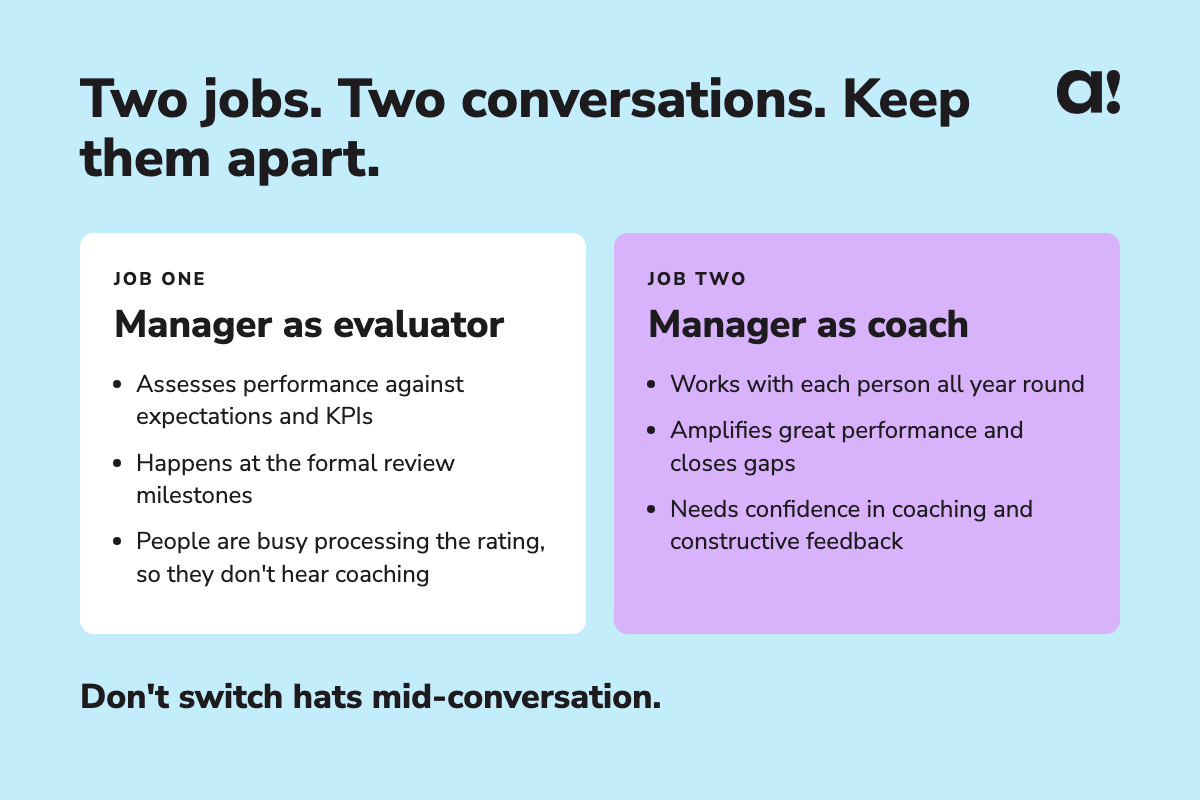
The fix starts with being clear that a manager has two different jobs.
In the first, the manager is an evaluator. They assess each team member's performance against expectations and KPIs. This typically happens at the formal review milestones during the year.
In the second, the manager is a coach. They work with each team member all year round to amplify great performance and, where needed, close performance gaps. This is where career development lives.
Here's the part that trips people up: you can't do both at the same time. It's really hard to context switch between evaluator and coach inside one conversation. And most people don't hear coaching when they've just received an evaluation, because they're busy processing the evaluation.
Whatever you say about their growth tends to bounce straight off.
So separate them. The coaching conversations should happen well before the formal review, so nothing in the evaluation is a surprise, and they should carry on afterwards when the dust has settled. If your managers have invested time in performance coaching, the performance evaluation should be a breeze!
What this asks of your managers
Here's the catch. Coaching, and giving constructive feedback, are two areas where managers are typically not strong, and many aren't confident. Hand them a new process without building those skills and you'll end up with another tick box exercise. Managers need practice at asking rather than telling, at giving feedback people can use, and at running a meaningful development conversation.
A few simple ways to start building career development into your process:
Name the two modes in your performance process, and brief managers on which hat they're wearing in each conversation.
Diary regular coaching conversations that sit apart from the review milestones.
Use those conversations to talk about strengths, interests and next steps, not just current KPIs.
Keep brief notes after each coaching conversation. They give you something to refer back to at review time, and the recency effect has less room to creep in.
Build manager confidence with practice and support, not just a policy.
Get these pieces in place and your review process stops being a once-a-year event and becomes part of how your managers grow your people all year. If your managers could use help building their coaching skills, have a look at our coaching for performance and development programmes. You might also like our posts on why career conversations are so hard and the 11 obstacles to meaningful development conversations. Get in touch to find out more or book an intro chat.
