
TL;DR
Organisations typically offer EAP when roles are disestablished, and some offer outplacement to get people job market ready. Both matter, but on their own they aren't enough. Proper support is part of a plan that maps what your people need at each stage of the restructure. It starts when the change is announced (or ideally before), and looks after your leaders, your change-affected people and the team that stays.
Key Takeaways
EAP plus outplacement is the default, not the finish line. Plan support for every stage of the change.
Map your people's experience of the restructure like you would a customer journey, step by step.
Start before the announcement, and prepare your leaders first.
Leaders need to know the HR process, how to communicate with empathy and how to handle a distressed team member.
Update people often, even when there's nothing new to report.
Plan how the remaining team comes back together, not just how people leave.
You're going through a restructure, and you want to do right by the people affected. So you've lined up EAP and you're looking into outplacement support. You've planned the 'what' of the process and you know it will be legally sound. Good. But we hear, time and time again, that this is where the planning stops, and then the kinks nobody saw coming land on leaders who were never prepared for them. In this post, we'll share our thoughts on how to map support across each stage of a restructure, what to do before anyone is told, and how to look after the people who stay.
Think of it like a journey map
If you work in marketing or customer experience, you may already use customer journey maps. They chart what a customer is thinking, feeling and needing at each step of using your product or service. The same thinking works for your people. A restructure is a journey, and everyone is on it. Before the announcement, during consultation, when roles are confirmed, through notice, on the last day, and in the months afterwards for the team that stays, people need something different from you at each point.
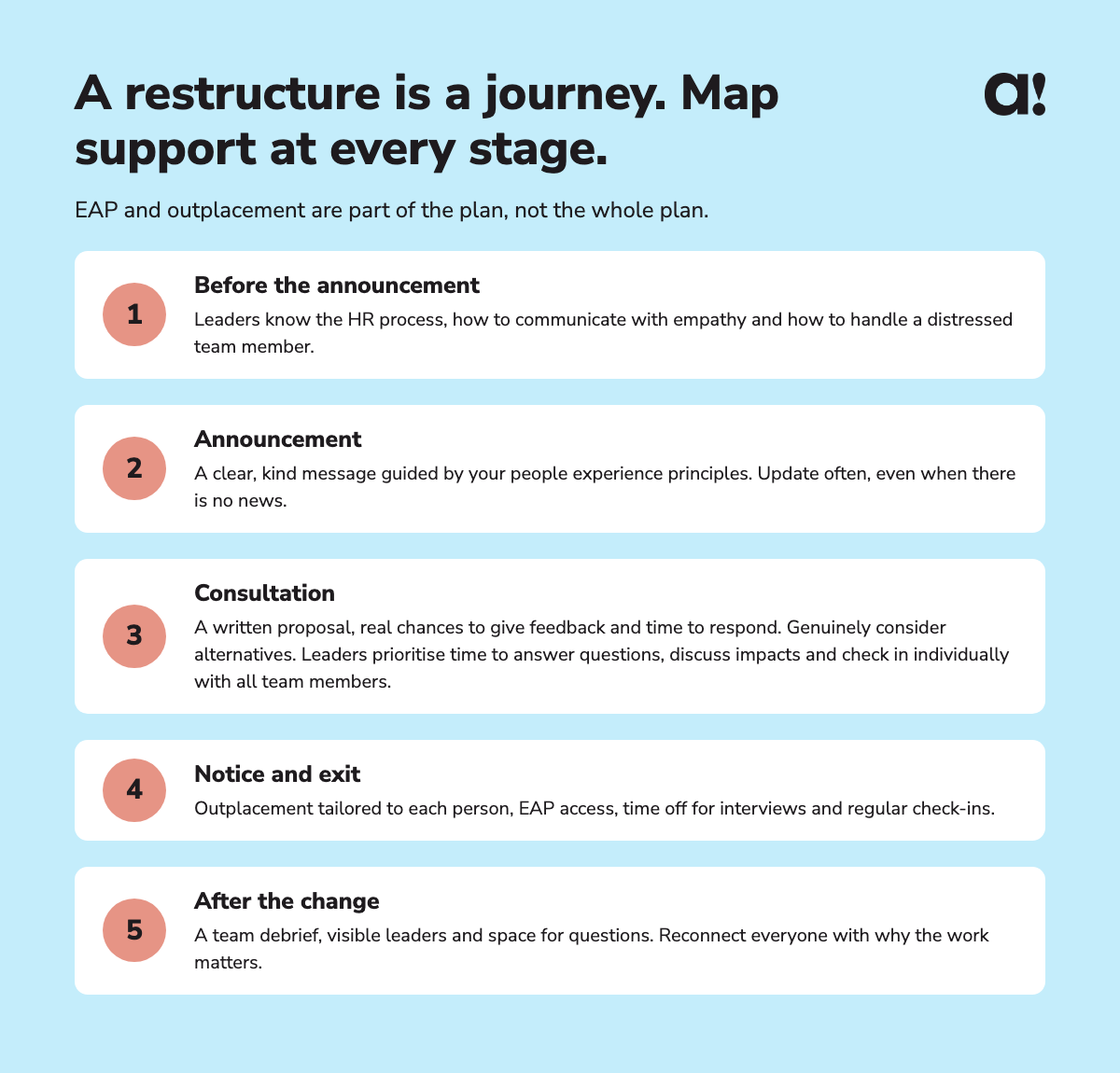
EAP is a great safety net, and outplacement gets change-affected people job market ready. But neither tells a leader what to say on announcement day, or what to do when someone in their team is in tears at their desk. Let's be honest, a restructure never runs perfectly, and there will always be kinks you didn't anticipate. Mapping support at each stage means you've thought about most of them before they arrive, and that's the best way we know to keep a big, hard process as smooth as it can be.
Before the announcement, get your leaders ready
Support should start as soon as the change is announced, and ideally before. The first people to look after are the leaders who will front it. Before anyone affected is told, make sure your leaders:
understand the HR process and what's expected of them at each stage
know how to communicate with empathy, and what not to say
know how to handle a distressed team member
know how to look after themselves during the change period. Leading change is stressful and lonely so they need as much support as their team members
understand why updating people often matters, even when there's nothing new to report
That last one surprises people. In a restructure, silence gets filled with worry or worse people make up their own stories, so a quick "no news yet, here's when you'll hear more" is worth far more than saying nothing. It also pays to agree a few people experience principles up front. Think communicating early and respectfully, treating everyone with dignity, avoiding surprises and protecting confidentiality. They give your leaders something to hold onto when emotions run high. Leaders also need to understand the psychological journey people go through in a change. The Bridges Transition Model is a handy one: an ending, a messy middle (the neutral zone) and a new beginning.
People move through each at their own pace, and a leader who knows that is more patient and a lot more useful. Finally, leaders will be asked questions they can't answer yet. Give them the words for "I don't know yet, and here's when I will", so they don't guess or go quiet.
Once it's announced, stay with people
After the announcement, the plan shifts to the people affected. Our guide to supporting employees through redundancy without damaging your employer brand covers each phase in detail, so here are the key points.
Run consultation properly.
That means a clear written proposal, real chances to give feedback and enough time to seek advice. It also means listening to that feedback and genuinely considering alternatives. Consultation that feels like a tick box exercise does real damage to trust. Offer outplacement support that is tailored. No paint by numbers here. One person needs help getting clear on their direction, another needs CV and interview coaching, and someone else needs to rebuild their network or their confidence. Pair it with other practical care: EAP access, time off for interviews, regular check-ins during notice, and entitlements explained clearly and paid on time. And keep your leaders in touch with departing people right up to their last day. Pulling away from someone who is leaving is one of the quickest ways to undo everything else you've done.
Communication matters all the way through.
If your leaders need a hand with it, our post on how to communicate a restructure with confidence is a good place to start.
Don't forget the people who stay
People who stay after a restructure are often more affected than you think, and they're watching how you treat their colleagues. Expect survivor guilt, worry about further cuts and a heavier workload. Plan how you'll bring the team back together before the change wraps up. That might mean a team debrief rather than a push straight back to business as usual; clear communication about what's changing; meeting with each individual to understand workload and help with prioritisation as you work through those changes - what needs to stop/start/continue; visible leaders and plenty of space for questions. Then reconnect everyone with why their work matters.
When people see a colleague treated well on the way out, it eases the guilt and helps the team keep performing. We cover this in more depth in managing a company restructure: looking after the people who stay. Doing this well isn't about a longer checklist. It's about thinking through the whole journey, for everyone on it, before the first conversation happens. If you're planning a restructure and want support that goes further than an EAP and a CV workshop, find out more about our redundancy support for organisations and our outplacement services in Auckland.
Contact us to find out more or book an intro chat.